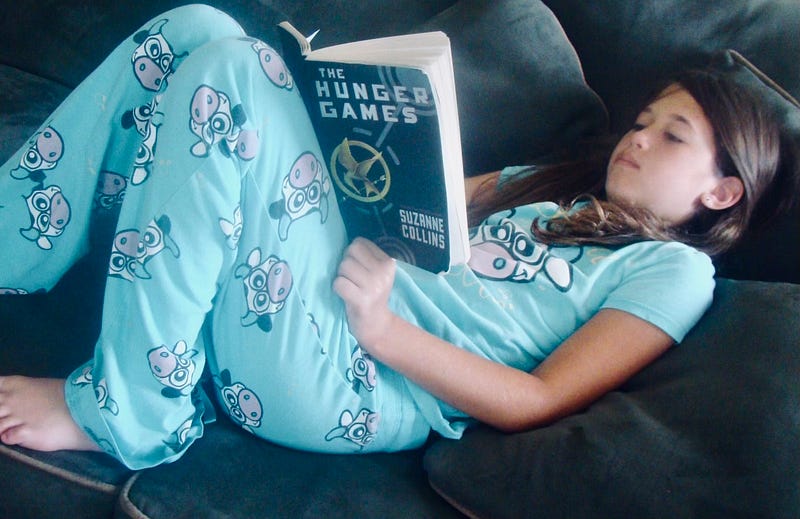
Hannah decided on Colleen Hoover’s, It Ends with Us, for our two-person book club, and when she returned from college, home for Winter Break, a copy of the book was on her bedroom dresser, patiently awaiting her arrival.
A few nights later, Hannah was ready to read.
I quickly put on my go-to pajama bottoms, favorite t-shirt, and five-dollar Amazon Readers. I plopped down on her bed — right beside her.
We paused.
No thoughts about final grades. No thoughts about COVID. No thoughts about tomorrow’s workday.
For those eight chapters, I connected to my 20-year-old daughter and that is priceless.
The next day, we finished the book. She immediately started her search for our next mother-daughter book club and went with a friend’s recommendation. I found People We Meet on Vacation on Libby and ordered Hannah a copy from Amazon. She will donate her copy to her sorority’s library when she returns to school in January.
In a New York Times article, How to Raise a Reader, Pamela Paul and Maria Russo agree that “a parent-child (any combination) book club is a great way to strengthen your child’s relationship to reading — and to you.”
As an elementary school teacher, I understood my responsibility to Charlie and Hannah — even before they were born.
I was well aware that “Reading aloud makes readers. Reading aloud makes writers. Reading aloud changes lives” (Kate DiCamillo, author of Because of Winn-Dixie, cited in Jim Trelease’s Read-Aloud Handbook Eighth Edition, 2019).
Because of what I knew, I made sure that every morning, before we headed out to school (work for me), I read aloud to them.
Inkheart, The Girl Who Could Fly, The Penderwicks, Each Little Bird That Sings, Masterpiece, The Lion, The Witch and The Wardrobe, The View From Saturday, The Tale of Despereaux, The Miraculous Journey of Edward Tulane, Everything on a Waffle….Those are the ones I remember. I know there were many more.
Throughout the years, I have been reminded over and over again, that “the single most important activity for building the knowledge required for eventual success in reading is reading aloud to children” (Jim Trelease, Read-Aloud Handbook Eighth Edition, 2019).
I read aloud to my students in the same way that I read aloud to Charlie and Hannah. It is my responsibility as both an educator and as a mom.
A few months ago, after finishing Pernille Ripp’s inspirational book Passionate Readers: The Art of Reaching and Engaging Every Child, I could not stop thinking about a very disturbing statistic pointed out in her book.
Charlie and Hannah fall in this age group, and I do not want them to become part of the statistic. I want them to be readers.
“Being a reader gives you an advantage in many areas of life, such as having more empathy, being less stressed, making you feel more connected, and keeping your brain younger longer.” — Pernille Ripp
Of course, I want this for my children — and for my students.
Who wouldn’t?
Subscribe to Insights from Educate for a biweekly dose of professional learning and inspiration from authentic voices in education.