Every afternoon, I welcome two groups of second graders, at two different times.
They come with high expectations; when they leave, thirty minutes later, they assume that they will understand math more than they did the day before, and that is on me.
Lesson plans follow our math department’s Scope and Sequence, which is “an important step in the design of effective teaching and learning programs”.
Our county’s Scope and Sequence includes a timeline for me to follow so I know when to teach specific math standards.
So far, we have dived deeply into eleven standards. Fifteen more to go.
I created a chart; it is constantly revised and edited and leans on a stand in the front of my room showing a condensed version of the required second grade math standards introduced so far this year.
It is my job to give them these experiences.
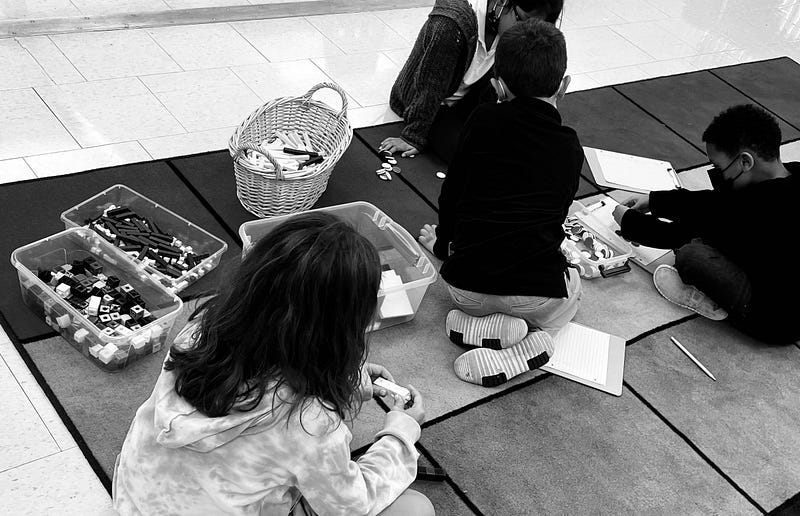
Once, and sometimes twice a week, I leave my classroom chairs stacked. On one rectangular table, I pile our tubs of red and yellow counters, linking cubes, Base Ten Blocks, play money, and 3” x 3” white construction paper squares. Then, we gather around the other rectangular table.
The chart is our guide.
We scoop red and yellow two-colored counters, dividing them up to determine odd or even.
We snap linking cubes together, making rectangular arrays — lots of them. We repeat addition sentences aloud: “Six plus six plus six plus six…” laughing as our words turn into tongue twisters. We use Base Ten Blocks to see one hundred more, one hundred less, ten more, ten less.
We use Base Ten Blocks to add and subtract.
We trade a ten for ten ones. We see what regrouping looks like. We count the ones and see that when we get to ten ones we can trade them in for a ten.
We use play money and act out different scenarios.
“Aunt Lainie gave me $25. I already had $9. I wonder how much money I will have left after I buy that $12 book.” I remind them that they can always get clipboards, paper, and pencils. They can write out problems, use lines, squares, and question marks to represent the unknown.
We write one digit, two-digit and three-digit numbers on the white construction paper and put them in order from smallest to biggest.
I remind them that they can always take a snack-size Ziploc bag to hold their number cards, an easy way for them to take their numbers home so they can play this “game” with their families. We “do” fact families aloud, hearing the three numbers rearranged in four different ways, and we end with Base Ten Blocks, where we see expanded form come to life.
Interactive Modeling, this pause in our daily routine, is the reminder they need.
The next day, they are ready to start anew.
They choose what they work on and I am right there by their side, listening, engaging, counting, writing, thinking aloud….I am there to support them on their journeys, with the hope that they are becoming confident independent thinkers who are starting to understand numbers a little bit more than they did the day before.
Once each week, I eat lunch with a second-grade student, who has had to deal with unbearable heartache. One day, she asked if she could stay for math. She would always watch the first group of students coming in, just as she was going out.
I told her she could stay if it was okay with her classroom teacher. I did let her know that students who come to me are having a little trouble with math. I told her that it was my understanding that she had great math sense. She said that she did.
I told her that she could try out my room and decide if it was the right place for her. She decided she wanted to stay and try it out.
She showed up the next day.
I thought to myself, Okay, I am on the right path. I need to keep moving forward on this never-ending journey towards creating a math space, where students not only develop greater number sense, but a math space, where all students can thrive — a math space that meets a student’s individual needs so they actually want to come. That seems like the perfect goal.
Subscribe to Insights from Educate for a biweekly dose of professional learning and inspiration from authentic voices in education.