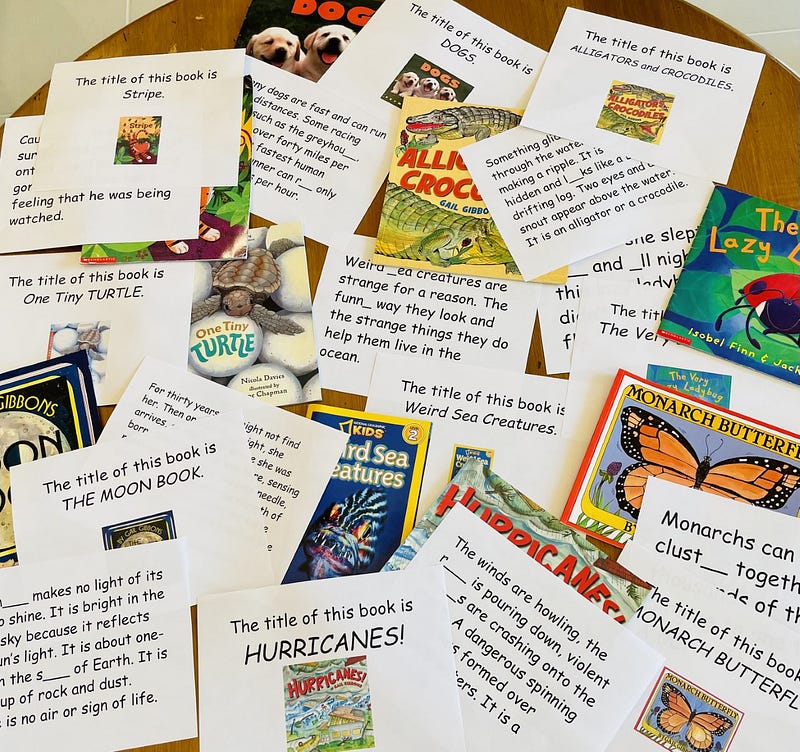
My friends gave me these books. One, a conscientious parent, the other, a once-upon-a-time elementary school teacher. The books inspired an idea.
Each week, on my outside bulletin board, I will display a paragraph, sprinkled with a few missing letters, and ask the question, What do you think the title of the book could be?
The following week, I will display the answer (the title) and hang up a new paragraph.
I am very excited about this.
An interactive bulletin board with a focus on main idea and phonics — just what administration ordered.
My last week of work. I received an email from my principal asking me to join him and our two assistant principals to discuss the language arts special, the class I will be teaching during the 2022–2023 school year.
Third grade reading scores were back. It showed that many of our students are not proficient readers. I wasn’t surprised. I worked with second graders and substituted in other grade levels. I knew.
After reviewing the data, administration concluded that next year’s language arts special needed to focus on main idea and phonics.
I listened.
I was ready to start reading and thinking and brainstorming ideas to make this thirty minute special meaningful. I will see each class, kindergarten through grade five, for three consecutive days, and then they will move onto their next special — PE, Art, Music or Media until it is time to return to me.
I will only see each student about thirty-six times out of the one hundred eighty day school year. I want the students to be excited to come to me and I want to be excited to be there. I will make that happen.
My thoughts.
The three days would be one lesson.
Day one. A mini lesson, an introduction, different ideas for different grade levels. Day two. Students will write and read and think and share and cross out and discuss and….I will listen and support and conference and share and think and… Day three. A final product — portfolio worthy.
Research, experience, and gut instinct told me that many of these kids are not getting read aloud to at home. That they are not surrounded by reading and writing outside of school. That they are not growing up in literacy-rich homes. So that’s where I would start. Where I always start. Fostering a love of learning.
But then.
One of the assistant principal’s spoke about her vision for my class, a vision that did not align with mine.
Her vision. That each of my three days would be a new mini lesson — videos, modeling, and practice. No fluff. One of the administrators said NO FLUFF.
I let them know that I do not do fluff. That I did not understand what they meant. Even though I knew exactly what they meant. I was told that this position had originally been created for me (in 2017) to do creative writing — but things have changed.
How sad that comment was. Worksheets and videos and drills are not fluff? Real reading and real writing and poetry and Writing Workshops and autonomy and creativity are fluff? Tears welled up in the corners of my eyes. I took lots of deep breaths. I remembered The Untethered Soul and my counseling sessions.
I suggested that I might not be the right person for this position. It was then that the reigns loosened.
That night I found this article in The Atlantic, adapted from Natalie Wexler’s book, The Knowledge Gap: The Hidden Cause of America’s Broken Education System — And How to Fix It. I emailed administration the link.
Elementary Education Has Gone Terribly Wrong
In the early grades, U.S. schools value reading-comprehension skills over knowledge. The results are devastating, especially for poor kids.
This article gave me the support and confidence to keep moving forward.
A K-1 carpeted area with a chart stand and chart paper. Sentence strips and sharpies and paper — all kinds of paper. A guided writing table where students can come to me for one-on-one attention. Tables everywhere so students can spread out. Purposeful. Meaningful. Clutter-free. Tons of books for inspiration and for taking. Crayons. Colored pencils. Highlighters. Markers. ABC charts. Poetry. Magazines. Space to move.
Through real books and poetry, I will do my very best to make this a special that the children look forward to coming to. I will make sure that I focus on main idea and phonics, but also a love of reading and writing — a love of learning.
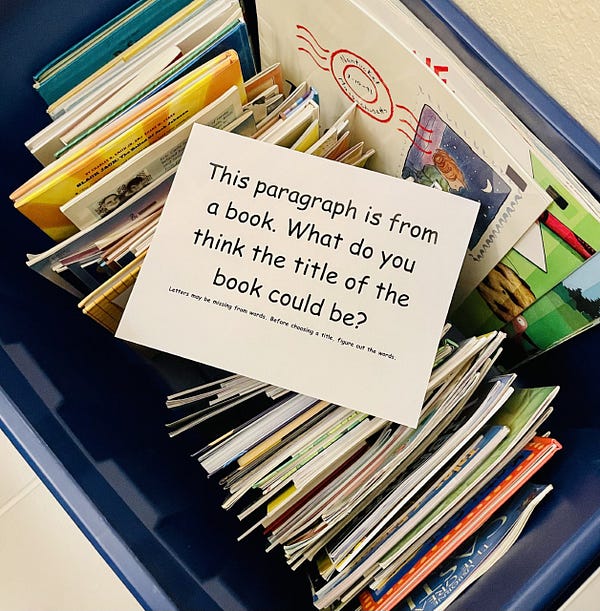
Standards I will hang outside my classroom and my latest order from Amazon.
I am so happy to be off for the summer, but teaching and education are a part of who I am, so when ideas pop into my head, I sit myself down and write and order and plan.
My goal. To make sure that the time I spend with these kids is worthwhile.
PS. I never received a response to my email with the link to the article. But that is okay. I was kind of hoping for no response. They had the option to give this position to someone else and they didn’t. I am going to take that as their confidence in me and their belief that I am absolutely the right teacher for this job.